Monday, November 12, 2012
Fifty Bird's Nests
Here are some stunning photographs of bird's nests and their eggs. These are taken from Sharon Beals' Nests: Fifty Nests and the Birds That Built Them. I am certainly adding this book to my wish list!


Thursday, November 8, 2012
Sleepy Mr. Toad
Whilst digging-in some leaves into my garden beds, I unintentionally woke this american toad up from his hibernating nap. This happens quite often this time of year because these garden beds are chock full of worms and mulch, providing a nice cozy soporific haven. I took a few pictures and carefully placed him under some mulch. Sweet dreams Mr. Toad!


Crisp Morning Fog
There was a crisp autumnal fog this morning. Temperature was right at the freezing mark.


Monday, September 17, 2012
Finally...Stream Sampling

Due to the severe drought, and no flowing water in our stream, we did not sample in either May or July. I have never seen the stream stagnant, even in previous droughts. Finally, with a few rains in September, we had just enough of a trickle of flowing water to sample. Shallow as it was, we were very careful to ensure that we sampled flowing water without disturbing the detritus on the stream bed. Having had no flowing water since March, the majority of the stream bed was covered in vegetation.

Tuesday, September 4, 2012
The Week of Box Turtles
I was heartented to see old Scarback. I had not seen him all summer and was concerned that maybe he was not able to find water during the severe drought. In fact, he was in the vicinity of our air conditioner when I spotted him, so when I released him, I placed him near the puddle of water that forms under the condensate drain.


Then, a few days later, I spotted another eastern box turtle that I had not seen before. The notch in the anterior marginal scute of his carapace will make it quite easy to re-identify him should he return.


Then, a few days later, a female showed up, and again, one that I had not seen before. Oddly, she also has some damage to the anteriror cervical and adjacent marginal scutes of her carapace that, in addition to her rather bright carapace markings, will make her easy to identify in the future.
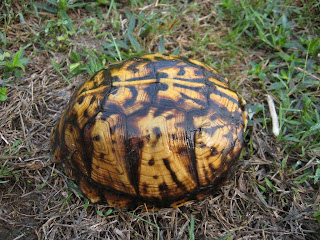

Why did I see three turtles in the spand of one week? I do not know. It is too early for them to be searching for a place to hibernate. Perhaps it is drought related.

Habits of the Box Tortoise by Alfred Goldsborough Mayer ~ Popular Science Monthly, November 1890


Then, a few days later, I spotted another eastern box turtle that I had not seen before. The notch in the anterior marginal scute of his carapace will make it quite easy to re-identify him should he return.


Then, a few days later, a female showed up, and again, one that I had not seen before. Oddly, she also has some damage to the anteriror cervical and adjacent marginal scutes of her carapace that, in addition to her rather bright carapace markings, will make her easy to identify in the future.


Why did I see three turtles in the spand of one week? I do not know. It is too early for them to be searching for a place to hibernate. Perhaps it is drought related.

(Ludwig Heinrich Bojanus 1819)
Habits of the Box Tortoise by Alfred Goldsborough Mayer ~ Popular Science Monthly, November 1890
Saturday, August 25, 2012
Fourth Clutch of Bluebird Eggs!
I was surprised to see these two eggs in the bluebird nest this late in the season. I have never had four sets of fledglings raised in a season...usually two and sometimes three.

Update: By September the eggs were still in the nest but no sign of any parents. There was no evidence of fowl play (pun intended) so I wonder what happened. The mother could have come to some misfortune outside of the vicinity of the nest but I am curious whether there could be some other explanation due to the lateness in the season. Four nestings are unheard of.

Update: By September the eggs were still in the nest but no sign of any parents. There was no evidence of fowl play (pun intended) so I wonder what happened. The mother could have come to some misfortune outside of the vicinity of the nest but I am curious whether there could be some other explanation due to the lateness in the season. Four nestings are unheard of.
Monday, July 9, 2012
Baby Skink
The boys spotted this baby five-lined skink and were able to successfully capture him long enough for us to take a few pictures and then release him back into the ivy.


Saturday, July 7, 2012

Thursday, June 28, 2012
Cozy Treefrog
I spotted this Cope's gray treefrog (Hyla chrysoscelis), in the garden nestled in the center of a zucchini squash leaf. He seemed very content and relaxed.

Gray treefrogs are able to change their color from gray to green based upon their immediate environment. The common gray treefrog (Hyla versicolor) found in more northern climes is not found in my region of Kentucky though it is physically indistinguishable from the Cope's gray treefrog. They can be distinguished by their calls, with the Cope's gray treefrog being shorter and faster. And quite interesting is the fact that the common grey treefrog has an extra set of chromosomes, which means that the two species can not hybridize.

Gray treefrogs are able to change their color from gray to green based upon their immediate environment. The common gray treefrog (Hyla versicolor) found in more northern climes is not found in my region of Kentucky though it is physically indistinguishable from the Cope's gray treefrog. They can be distinguished by their calls, with the Cope's gray treefrog being shorter and faster. And quite interesting is the fact that the common grey treefrog has an extra set of chromosomes, which means that the two species can not hybridize.
Thursday, June 7, 2012
More Bluebirds
I have been remiss in checking the bluebird house and low and behold, a second set of three fledglings were well along their way.


Subscribe to:
Posts (Atom)


