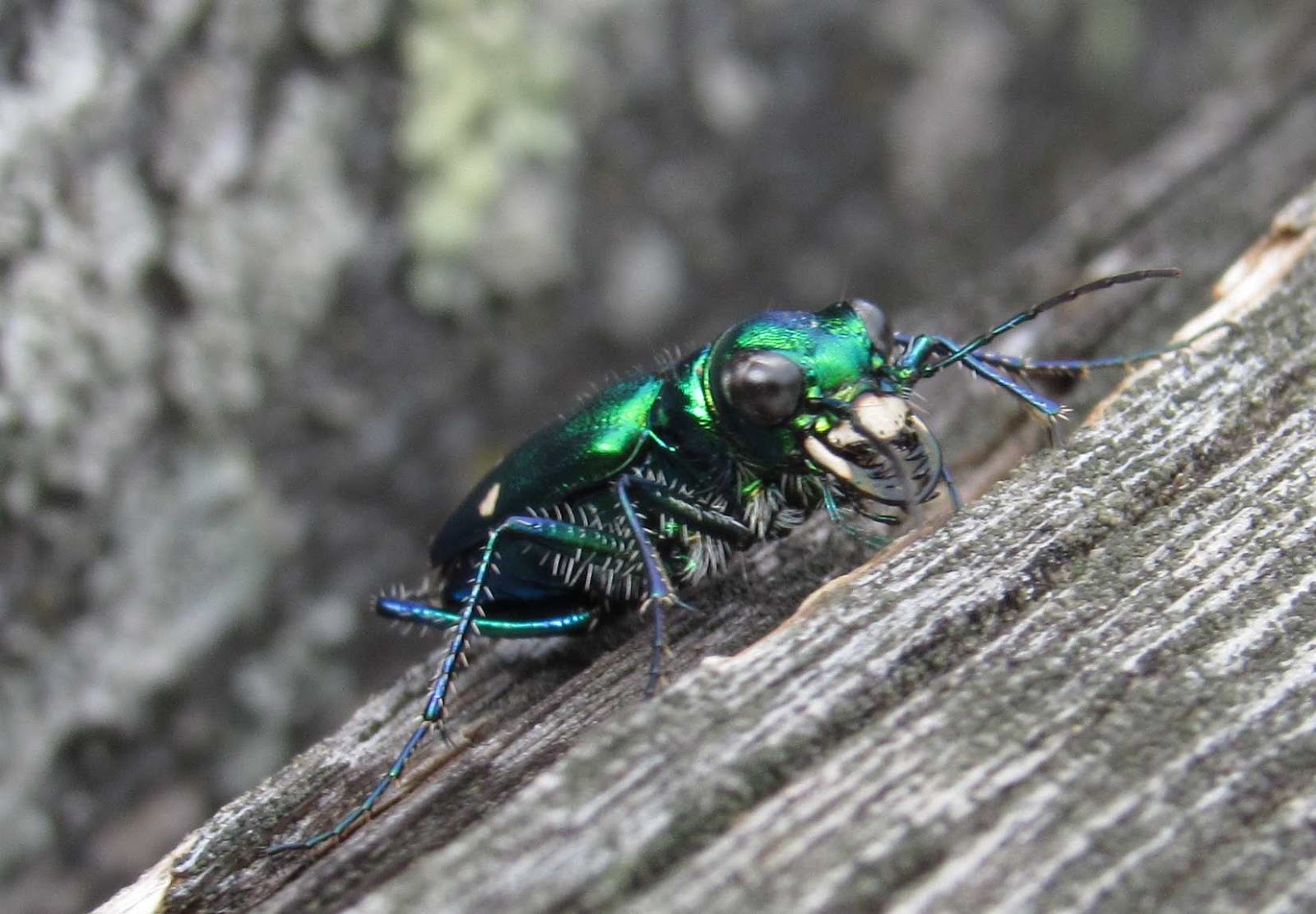
I noticed this beautifully luminescent six-spotted green tiger beetle (Cicindela lepida) on the picnic table.
The Audobon guide says, "The adult flies along forest paths, alights, and turns to face any intruders, as though judging when to fly again.". I observed this one exhibiting this precise behavior.
Showing posts with label insects. Show all posts
Thursday, June 2, 2016
Tuesday, May 24, 2016
Click Beetle
The
eastern eyed click beetle (Alaus oculatus)
is
often found around rotting timber and that is exactly where I found
this one….in a pile of old, rotting boards. It is named for the
false eyes that appear on the back of the thorax.
The
"click" refers to the sound that they make when they flip
themselves upright. According to the Audobon Field Guide, “they
accomplish this amazing feat by snapping a fingerlike spine on the
underside of the thorax into a groove below the mesothorax.”
Strangely, this particular one did not exhibit the phenomenon. He
just lays on his back playing dead.
Saturday, June 20, 2015
Year of the Cicada
This is the year for Brood XXIII periodical cicada which emerge every 13 years...genus Magicicada. Shown above are the empty nymph exoskeleton on a burr oak.
I rather enjoy the sound of the annual cicadas...particularly in the morning. On the other hand....the periodical cicadas....their deafening and never ending buzz can be unnerving.
After slicing open a small tree twig with her ovipositor, the female cicada lays her eggs in the open wound. The shear quantity of egg deposit sites will result in some damage to the outer small, thin branches of the trees. Over the summer, I watched a rather large pin oak, drop a good number of twigs. Very young trees can receive significant damage as happened to an apple seedling that I had planted last year.
Shown below is the emergence range of Brood XXIII for 2015.
Saturday, April 25, 2015
Small Hornet's Nest
This is the start of a hornet's nest on the light fixture at our front door. It is likely a bald-faced hornet (Dolichovespata maculata)....also known as an "arial yellowjacket"...though I did not wait around to see exactly who showed up. This home was removed for the safety of those that dwell in the home to which it is attached.
Thursday, July 11, 2013
Baby Mantis
This is the smallest praying mantis (Mantis religiosa) that I have been able to document...perhaps around 5/8" long.
They are typically found in the boxwood shrubs on the north side of the house. They manifest themselves during the dog-days of late summer when the shrubs are in need of watering. They don't seem to appreciate the shower as it forces them out of the dark inner recesses of the boxwood canopy where they hunt their prey. This baby found temporary refuge on the side of the house.
Thursday, November 15, 2012
Leave No Leaf Unturned
Thanks to Chris Rawlings at Invertebrates & More, I have been paying much closer attention to what is on the underside of leaves. (It always seems to come back to the importance of observation.) Here are some opened egg casings on a willow oak leaf. Probably from moth or butterfly larvae.
Saturday, April 28, 2012
Watershed Watch Training
My oldest son and I have been volunteer water samplers and habitat/biological assessors for Four Rivers Watershed Watch for five years. My son will be going away to college in the fall so he is passing the torch to son no. 2. Providentially, the organization is implementing enough changes to the procedures and criteria that re-training was deemed necessary for all samplers, so it was very timely for son no. 2. The lecture part of the training was held at the local community college. We then went to a local stream for some hands-on biological sampling as well as habitat assessment. It was unseasonably warm and we found many examples of dragonfly, mayfly, and stonefly nymphs. This creek is unusually low for this time of year but it did make it easier for the training.
Friday, April 13, 2012
Luna Moth
This rather lethargic Luna moth (Actius luna) was hanging around the rear of the house this early this morning. The left hind wing was slightly damaged but it did not appear to affect his flight later in the day. It should do for his vaporous one week life.
Tuesday, June 1, 2010
The Dreaded Japanese Beetle

It is that time of year when the dreaded Japanese Beetle (Popillia japonica) ascends upon us. I had my first sighting of some today. I say "ascends" because they live as larva in the soil and after they pupate, they emerge as adults.
They play havoc with a number of plants, eating the flesh of the leaves while ignoring the veins. In the vegetable garden, they will concentrate on any bean species and they also like blackberries, though they will not harm the fruit. I have noticed that they like to eat taller leaves rather than those closer to the ground when given a choice. For example, if pole beans are available, they will virtually ignore the bush beans. In my yard, I have noticed that they also have certain preferences. Roses seem to be their favorite including the invasive Multiflora Rose. They also gravitate to my Japanese White Birch and Japanese Maple. They loved the Chinese Elm prior to its demise in the aforementioned ice storm. They don't seem to like any of the native oaks or maples. They go completely crazy over the wild grapes as well.
We first observed them here around 5 years ago. They seemed to grow in numbers the first 4 years. I placed traps out in two locations within our 3 acre smallholding. The traps use a pheromone to attract the beetles. When they land on the piece holding the bait, they drop into the bag. The traps must be carefully located. If they are too far from their favorite plants, they will not be drawn to the traps. If they are too close, the traps will draw them to the plants as well. During their peak activity, I would regularly empty a full bag every day at each location.

Our land is surrounded by woods and I began to wonder if I was not simply doing more harm than good with the traps. Was I drawing more beetles from the woods? So last year I did not put up any traps. Not only did I not see as many beetles on their favorite plants, I did not have to empty those nasty bags every day! I have since discovered that a University of Kentucky study indicates that the traps do draw more than protect.
They can be controlled in the larval stage with application of the bacterium milky spore. However, it can take several years of applications to eradicate them. Further, to do so on 3 acres would be too expensive and finally, they can simply fly in from any neighboring area.
I have also noted that the moles have been quite active this year. This is usually an indicator of an increase in grubs. I hope that the grubs that they were feasting on are not Japanese Beetle larvae! I will keep you posted as the season progresses.
Here is a distribution map in case you are wondering if they are heading your way.
Saturday, December 6, 2008
Cicadas and Their Killers
The Eastern cicada killer wasps (genus Sphecius) were in full force this fall. Here is the common annual cicada (genus Tibicen) along with its foe collected on our smallholding.

The cicada killer females build nest cells within tunnels which they burrow in the soil often working with other females. The females are often seen flitting about in search for their prey. Once located, they sting the cidada and paralyze it so that they can laboriously lug it back to their nest. Once in the nest cell, which is a branch off of the main tunnel, the female cidada killer will place an egg on the cidada and close off the nest cell with surrounding soil. In a few days, the egg will hatch a grub which will feed off of the cicada as it develops. In about two weeks, the larvae will come to maturity and will spend the winter in a cozy cocoon within the nest cell. In the spring, they pupate. Alas, the adults do not survive the winter.
What is quite intriguing is that an egg that contains a female cicada killer will receive 2 or 3 cicadas in its nest cell for feeding whilst an egg that contains a male cicada killer will receive only one cicada in its nest cell. This is because the female cicada killer is nearly twice as large as the male and thus requires more food whilst developing. Only God knows how the female can tell a male containing egg from a female containing egg.
I particularly enjoy the mellow background buzz of the morning cicada especially whilst working in the garden or elsewhere around the homestead.
P.S. My intent is to keep the journal entries relevant to the season at hand, however, I will occasionally make an exception.

The cicada killer females build nest cells within tunnels which they burrow in the soil often working with other females. The females are often seen flitting about in search for their prey. Once located, they sting the cidada and paralyze it so that they can laboriously lug it back to their nest. Once in the nest cell, which is a branch off of the main tunnel, the female cidada killer will place an egg on the cidada and close off the nest cell with surrounding soil. In a few days, the egg will hatch a grub which will feed off of the cicada as it develops. In about two weeks, the larvae will come to maturity and will spend the winter in a cozy cocoon within the nest cell. In the spring, they pupate. Alas, the adults do not survive the winter.
What is quite intriguing is that an egg that contains a female cicada killer will receive 2 or 3 cicadas in its nest cell for feeding whilst an egg that contains a male cicada killer will receive only one cicada in its nest cell. This is because the female cicada killer is nearly twice as large as the male and thus requires more food whilst developing. Only God knows how the female can tell a male containing egg from a female containing egg.
I particularly enjoy the mellow background buzz of the morning cicada especially whilst working in the garden or elsewhere around the homestead.
P.S. My intent is to keep the journal entries relevant to the season at hand, however, I will occasionally make an exception.
Wednesday, November 19, 2008
Mushrooms and Woodchucks
I need to catch up on some observations from October.
Whilst moving leaves into the compost pile, I discovered these rather small but bright mushrooms buried in the leaves. As yet, I have not been able to identify them but it is possible that they have not yet reached their mature form and color.

I regularly take a walk down a lane that runs into the countryside. I had noticed a woodchuck (Marmota monax) living in an embankment which was covered with the highly invasive Kudzu. A county road crew was mowing the shoulders of the road and exposed Mr. Woodchuck's hobbit hole. I have only seen him in quick flashes of fur as he dives into his warm abode.

Here is a very small, 3-legged praying mantis (Mantis religioso) on our fence rail in typical "praying" stance and mimicking the color of the fence. I noticed many praying mantises around the homestead this fall. While they do eat many undesirable insects in the garden, they do not discriminate and will eat beneficial ones as well.
Whilst moving leaves into the compost pile, I discovered these rather small but bright mushrooms buried in the leaves. As yet, I have not been able to identify them but it is possible that they have not yet reached their mature form and color.

I regularly take a walk down a lane that runs into the countryside. I had noticed a woodchuck (Marmota monax) living in an embankment which was covered with the highly invasive Kudzu. A county road crew was mowing the shoulders of the road and exposed Mr. Woodchuck's hobbit hole. I have only seen him in quick flashes of fur as he dives into his warm abode.

Here is a very small, 3-legged praying mantis (Mantis religioso) on our fence rail in typical "praying" stance and mimicking the color of the fence. I noticed many praying mantises around the homestead this fall. While they do eat many undesirable insects in the garden, they do not discriminate and will eat beneficial ones as well.
Subscribe to:
Posts (Atom)


