
Saturday, November 17, 2012
Cedar Waxwing Feast
I watched cedar waxwings quietly blanketing a black tupelo tree and devouring the ripe, blue fruit.


Thursday, November 15, 2012
Leave No Leaf Unturned
Thanks to Chris Rawlings at Invertebrates & More, I have been paying much closer attention to what is on the underside of leaves. (It always seems to come back to the importance of observation.) Here are some opened egg casings on a willow oak leaf. Probably from moth or butterfly larvae.


Wednesday, November 14, 2012
Green Brains

Green brains.....that is what my children call hedge apples. This time of year it is common in Kentucky to find the osage-orange trees (Maclura pomifera) dropping their hedge apple fruit. The fruit was named hedge apple both because of the large round shape (4"-5" diameter) and the fact that most osage-orange trees can be found along hedge and fence rows, and that is precisely where I stumbled upon this particular example.

As I cut open the fruit, it oozed a white sap quite profusely. This liquid dries very quickly into a sticky pitch-like substance which will not wash off with soap and water and would make a very effective water-proofing substance. I had to resort to mineral spirits to clean my knife. In the days of yore, hedge apples would be placed under beds to keep the spiders away. Scientific studies have shown that the sap of the fruit does indeed contain a substance which repels several insect species as effectively as our synthetic DEET insect repellent. However, you won't find me slathering the sap on my skin or clothing!
Dixon Springs

On Saturday, we visited Dixon Springs State Park in Southern Illinois. (I originally posted on Dixon Springs back in 2008.) It was a balmy 72 degF, and the fall colors were at an ebb which was a bit surprising given that just 45 minutes to the south in Kentucky, we are still enjoying a strong display of foliage.
The creek had still not recovered from our severe summer drought as there was no water in the creek above the dam in spite of recent rains. The spring was still producing a slight trickle which kept the pools from becoming stagnant.
We did our usual hike down Ghost Dance Canyon. The path was covered with recently fallen leaves which obscured much of the moss and a plenitude of hickory nuts.

I am always in awe of the distances a tree will send out its roots in search of soil, In this case, an eastern red cedar.


A sun-illuminated northern red oak.

Tuesday, November 13, 2012


Monday, November 12, 2012
Fifty Bird's Nests
Here are some stunning photographs of bird's nests and their eggs. These are taken from Sharon Beals' Nests: Fifty Nests and the Birds That Built Them. I am certainly adding this book to my wish list!
Thursday, November 8, 2012
Sleepy Mr. Toad
Whilst digging-in some leaves into my garden beds, I unintentionally woke this american toad up from his hibernating nap. This happens quite often this time of year because these garden beds are chock full of worms and mulch, providing a nice cozy soporific haven. I took a few pictures and carefully placed him under some mulch. Sweet dreams Mr. Toad!


Crisp Morning Fog
There was a crisp autumnal fog this morning. Temperature was right at the freezing mark.


Monday, September 17, 2012
Finally...Stream Sampling

Due to the severe drought, and no flowing water in our stream, we did not sample in either May or July. I have never seen the stream stagnant, even in previous droughts. Finally, with a few rains in September, we had just enough of a trickle of flowing water to sample. Shallow as it was, we were very careful to ensure that we sampled flowing water without disturbing the detritus on the stream bed. Having had no flowing water since March, the majority of the stream bed was covered in vegetation.

Tuesday, September 4, 2012
The Week of Box Turtles
I was heartented to see old Scarback. I had not seen him all summer and was concerned that maybe he was not able to find water during the severe drought. In fact, he was in the vicinity of our air conditioner when I spotted him, so when I released him, I placed him near the puddle of water that forms under the condensate drain.


Then, a few days later, I spotted another eastern box turtle that I had not seen before. The notch in the anterior marginal scute of his carapace will make it quite easy to re-identify him should he return.


Then, a few days later, a female showed up, and again, one that I had not seen before. Oddly, she also has some damage to the anteriror cervical and adjacent marginal scutes of her carapace that, in addition to her rather bright carapace markings, will make her easy to identify in the future.
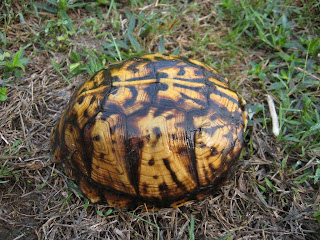

Why did I see three turtles in the spand of one week? I do not know. It is too early for them to be searching for a place to hibernate. Perhaps it is drought related.

Habits of the Box Tortoise by Alfred Goldsborough Mayer ~ Popular Science Monthly, November 1890


Then, a few days later, I spotted another eastern box turtle that I had not seen before. The notch in the anterior marginal scute of his carapace will make it quite easy to re-identify him should he return.


Then, a few days later, a female showed up, and again, one that I had not seen before. Oddly, she also has some damage to the anteriror cervical and adjacent marginal scutes of her carapace that, in addition to her rather bright carapace markings, will make her easy to identify in the future.


Why did I see three turtles in the spand of one week? I do not know. It is too early for them to be searching for a place to hibernate. Perhaps it is drought related.

(Ludwig Heinrich Bojanus 1819)
Habits of the Box Tortoise by Alfred Goldsborough Mayer ~ Popular Science Monthly, November 1890
Subscribe to:
Posts (Atom)


